Choosing eco-friendly products isn’t just about conscience—it’s about cost, access, and knowing what’s truly green.
The Price of Doing Good
On paper, choosing more sustainable products is a no-brainer: you get a quality product that minimizes environmental impact. Many are drawn to eco-friendly products for their unique benefits, seeing them as alternatives to their usual products and a way to support the planet.
And in a country where wealth disparity remains high and ESG awareness is still a work-in-progress, buying “sustainably” isn’t just a transaction — it’s a statement of principle.
Yet for many, “going green” isn’t just by turning over a new leaf. It comes with a cost, posing a challenge to both their finances and values.
Who’s Willing to Pay the “Green Premium”?
Sticking to your principles often comes at a price — and not everyone can afford them. Many consumers weigh their choices based on their current circumstances, and sometimes those circumstances hinder them from making purchases that align with their ideals.
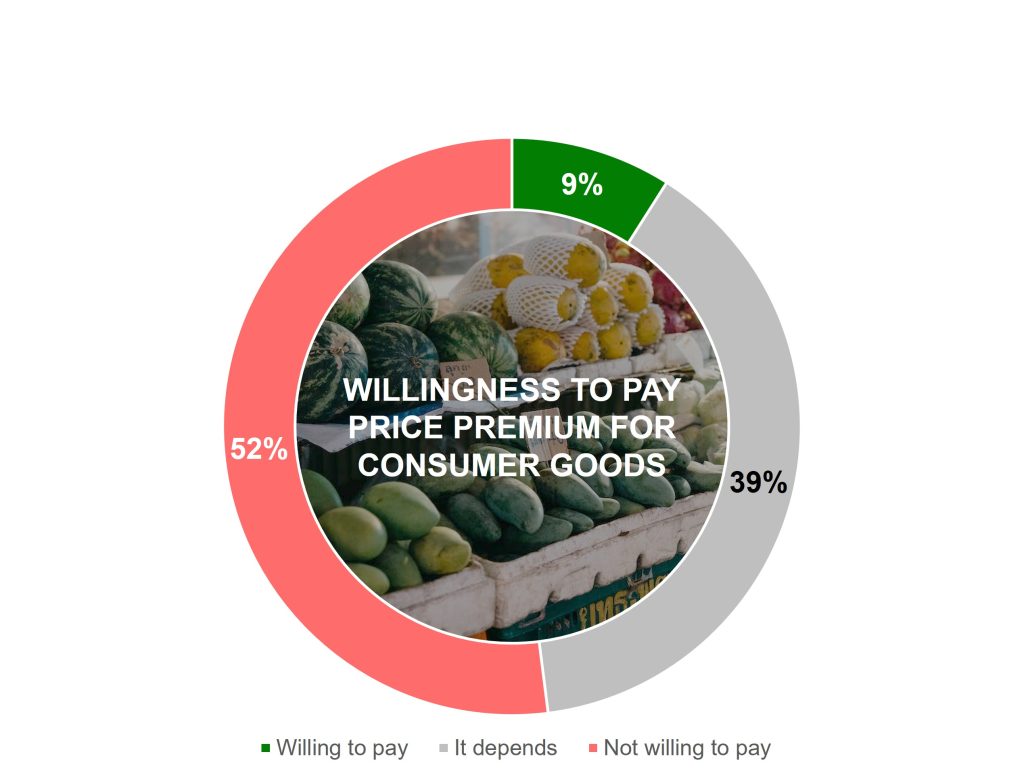
In our 2023 survey, only a minority of respondents (9%) said they were willing to pay a premium for green-aligned consumer goods. The majority of Filipinos are either unwilling (52%) or are still measuring this depending on other factors (39%).
This middle group represents the persuadable consumers—those who aren’t rejecting sustainability but are waiting for proof. Perhaps that these higher priced products will have a real impact on society, not just better branding.
For most, sustainability is aspirational but impractical. Not because they don’t care, but because “eco-conscious” still feels like a luxury good.
💡 INSIGHT: Filipinos aren’t closed on the idea of spending on environmental premiums — they’re unconvinced.
Whose Mandate Is It Anyway?
Interestingly, when asked who should bear the cost of sustainability, Filipinos point to the government.
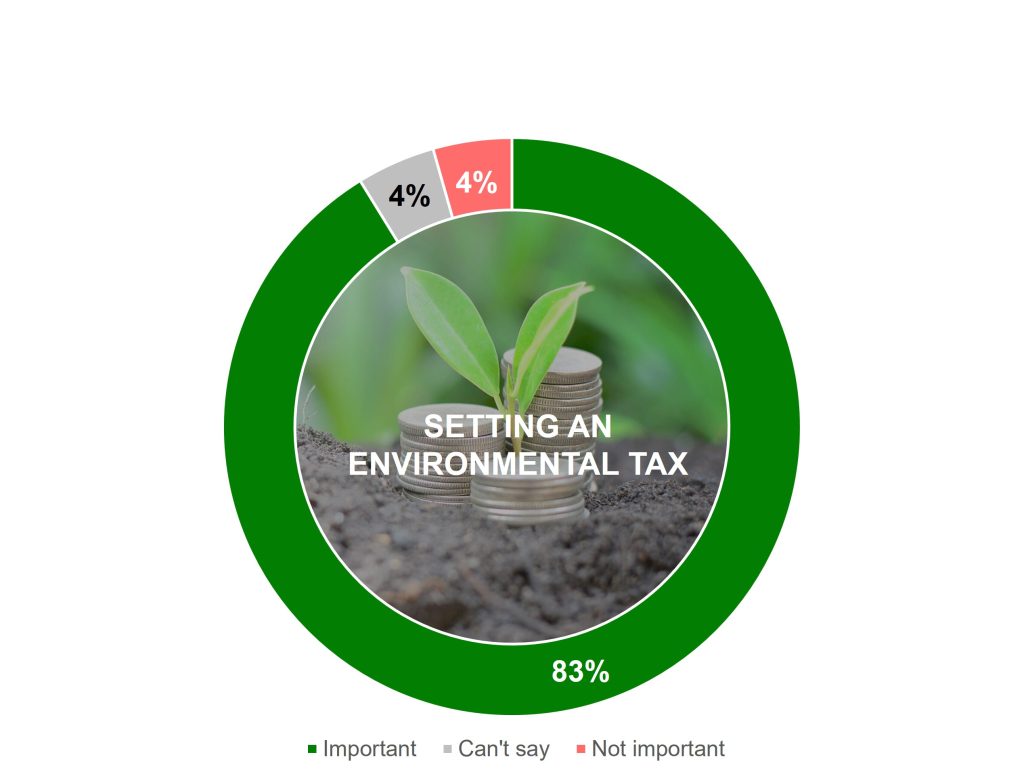
While most are reluctant to pay more for eco-friendly products, they’re more open to environmental taxes or levies when these are implemented by government policy. In fact, 83% of respondents view environmental taxes as an essential tool for addressing the impact of environmental issues in society.
This suggests that Filipinos see sustainability as a shared, systemic responsibility — not just a personal or corporate one. The public gives the government greater legitimacy to enforce environmental measures, compared to companies imposing higher prices on their own.
This “mandate gap” highlights a crucial mindset: sustainability is viewed as a public good, not a private choice by corporations.
💡 INSIGHT: For Filipinos, sustainability has more weight when it feels like policy — not marketing.
Bridging the Green Information Gap
Even when the intent is there, understanding often isn’t.
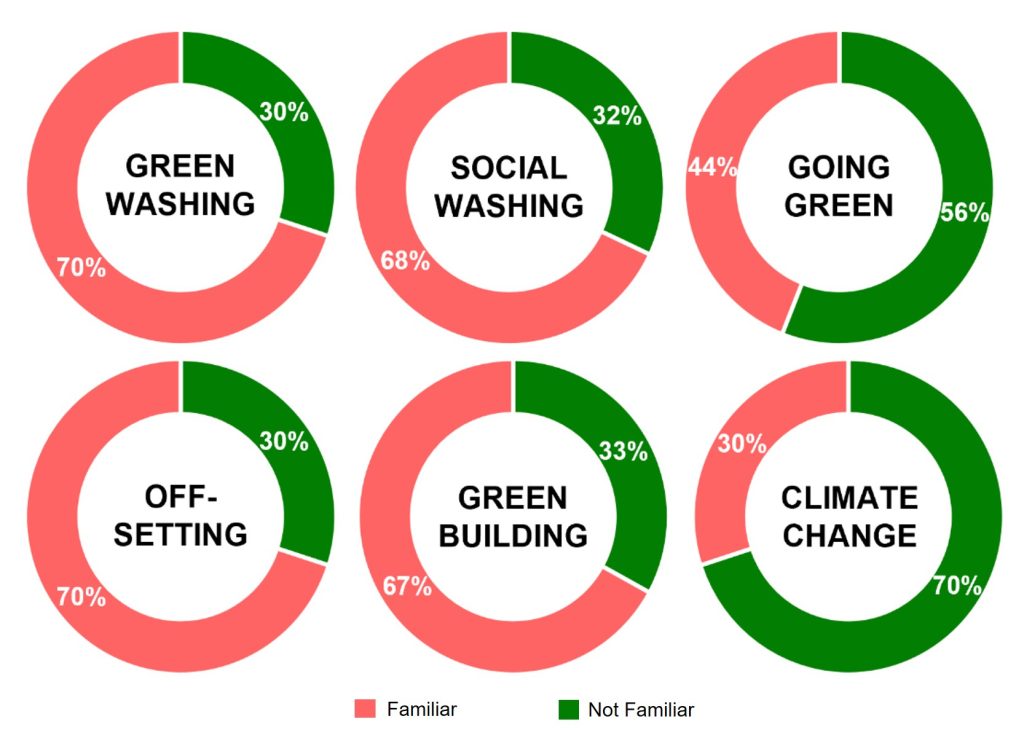
Awareness remains highest for broad, everyday terms like “Global Warming” (70%) and “Going Green” (56%).
But awareness drops sharply for more technical ESG terms — the kind that function to define and guide sustainable action:
- ➣ Greenwashing – 30%
- ➣ Offsetting – 30%
- ➣ Social Washing – 32%
It’s a pattern that mirrors overall ESG awareness, which sits at just 35% nationally.
Filipinos understand why sustainability matters — they just lack the vocabulary to recognize what makes something truly sustainable.
💡 INSIGHT: Filipinos need a deeper understanding of ESG to better separate genuine green practices from performative “green marketing.”
Key Takeaways
Despite strong interest in sustainability, the data shows that several barriers — from cost to awareness — still shape how Filipinos make “green” choices.
- 1. Belief vs. Budget: Filipinos care about sustainability, but financial realities make green choices feel out of reach.
- 2. Mandate Matters: People trust government action on sustainability more than private-sector pricing.
- 3. Knowledge Gap: Awareness of ESG remains low, limiting consumers’ ability to choose wisely.
- 4. Beyond Cost: Affordability is only one piece of a larger puzzle that includes trust, access, and credibility.
Share


How do you feel about this article?


Survey Details
Project ESG, 2023
This survey was conducted across 17 countries, covering all major continents, with a total random sample size of N=9,627 respondents interviewed globally. In each country, a representative sample of around 400 to 1,000 men and women was randomly selected. Data was collected through a combination of face-to-face, telephone, and online interviews, using a structured questionnaire. Studies were conducted by research agency partners within AGMR.