Filipinos expect companies to show tangible evidence of their ESG efforts—”resibo” that ethical practices are real, not just nice-sounding jargon.
Resibo as Proof of Integrity
Nothing galvanizes the country like concern over corruption. From politics to daily life, Filipinos want accountability they can see and trust. But the demand for integrity doesn’t stop at government offices—they expect clean corporate governance.
The everyday Filipino interacts more directly with their employer than with national institutions. Perhaps this is why 69% of Filipinos surveyed agree that bribery should have no place in the companies they work at.
In many ways, people want resibo: a form of accountability that companies are behaving ethically — just as they would expect their employees to act. Anti-bribery policies, tax compliance, and transparent corporate behavior go beyond formalities, serving as receipts of trust.
To turn this demand for accountability into measurable action, companies use frameworks to better structure this. ESG, short for the Environment, Social, and Corporate Governance, is one such framework.
The “G” in ESG: Governance as Accountability
Corporate Governance covers internal company policies, board oversight, risk management, anti-corruption measures, and compliance monitoring. Essentially, it’s the system that turns promises into practice.
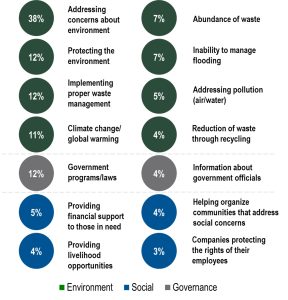
However, despite its importance, governance is the least understood ESG pillar: with only 12% associating “governance” with corporate rules/policies and instead of corporate by-rules for sustainable operations.
💡 INSIGHT: When Filipinos hear “governance,” they connect it to something more immediately familiar: local or national government.
Corruption Is a No-No
Even amid confusion about governance and government, one thing is clear: corruption should have no place in either.
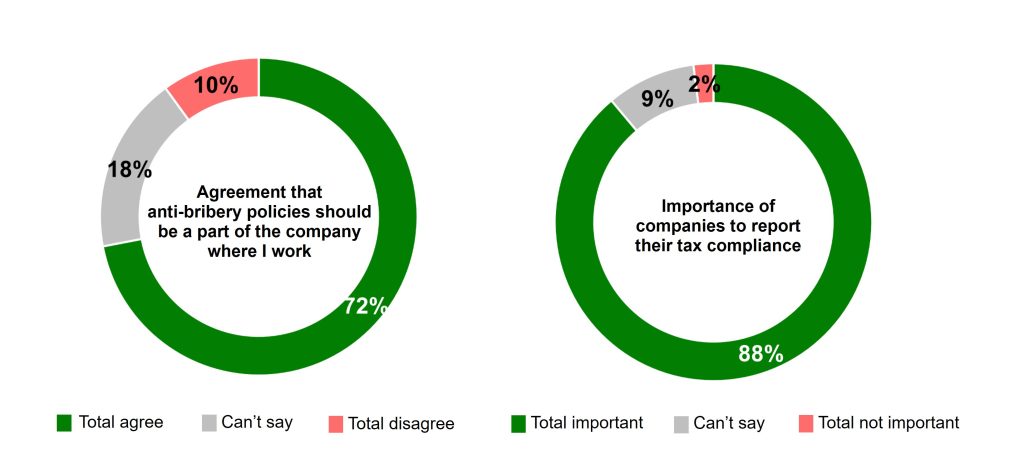
- ➣ Majority of the respondents (67%) support anti-bribery policies at work.
- ➣ An even bigger majority (88%) embrace transparency in tax compliance reporting.
This shows that Filipinos want assurance that companies are not supporting corruption or bribery. They want policies to be actively enforced and for companies to “walk the walk,” proving that corporate ethics are real—not just a fantasy.
Filipinos want companies to walk the walk—they want assurance that policies are enforced and corporate ethics are real.
Not Fully Convinced: Lukewarm Trust in ESG
While Filipinos care about corporate responsibility, they also remain adamant that there is still more to learn about its proper implementation. Only 58% believe that companies are truly committed to ESG today, signaling that intent alone isn’t enough to inspire confidence. This signals back to the call for proof: clearer evidence of what they are doing to protect their workers.
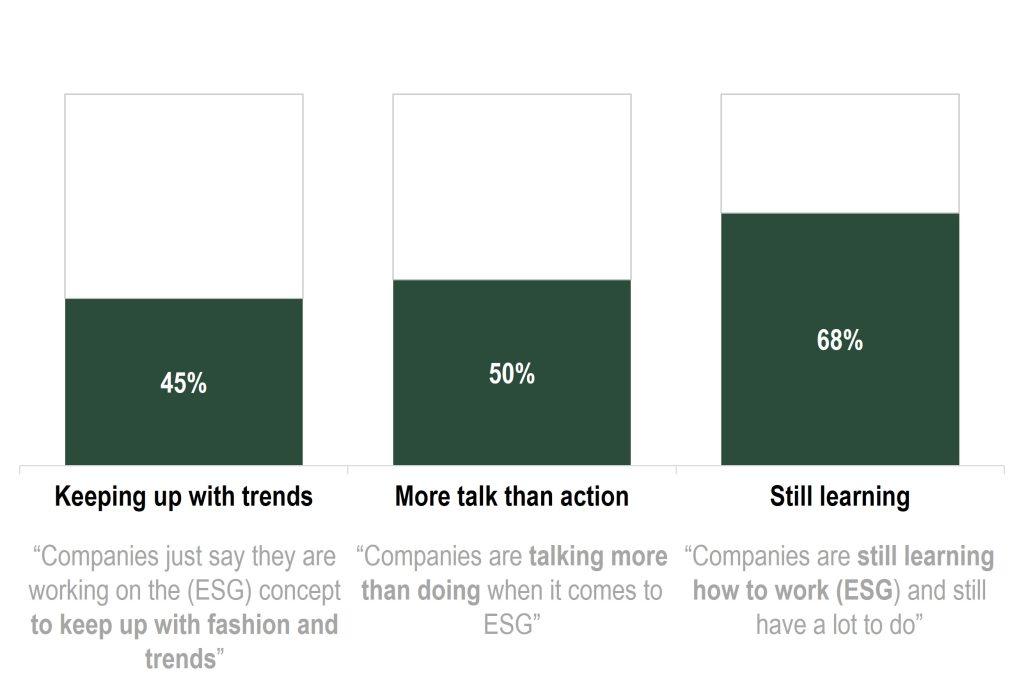
Many employees and consumers perceive ESG as more talk than action: 45% think companies adopt ESG merely to keep up with trends, while 50% feel companies are talking more than doing. And it’s not just cynicism—68% believe companies are still learning how to implement ESG properly, suggesting that missteps or lack of clear communication may undermine perception. This isn’t a rejection of ESG itself—it’s a demand for clearer practices.
💡 INSIGHT: Ethical business practices resonate beyond policy—they shape employee trust and consumer perception. Proof is the best cue to build credibility.
High Importance, High Responsibility
Filipinos don’t just care about what companies do internally—they also hold them accountable for the impact of their suppliers and partners. They expect transparency in every action, highlighting that responsibility isn’t optional and applies across the entire value chain.
Responsibility isn’t optional; it’s expected across the entire value chain.
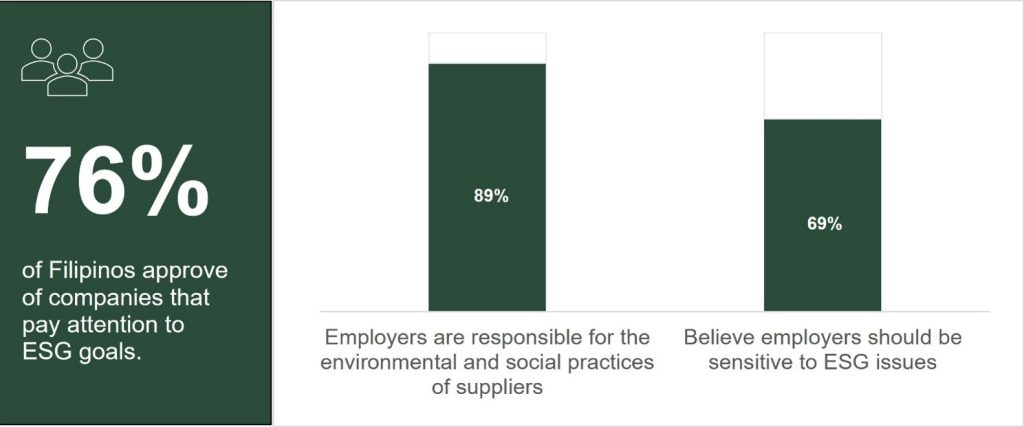
- ➣ 69% of employees believe employers should be sensitive to ESG issues.
- ➣ 89% say employers are responsible for the environmental and social practices of their suppliers.
These are consistent with our earlier finding that when ESG is explained to respondents, 76% approve of companies that actively pursue ESG goals. When businesses take responsibility and provide evidence of action both internally and across their supply chain—Filipinos are more likely to reward them with trust, credibility, and loyalty.
Let Others Show & Tell
Proof is more than doing; it’s showing. Companies that share progress on their commitment are expected to be trustworthy. Consumers want reports that can be verified, relying on the credibility of third-party sources such as independent organizations or other stakeholders.
Consumers want legitimate reporting and verification, and look to the reputability to come from third-party sources such as other individuals or organizations:
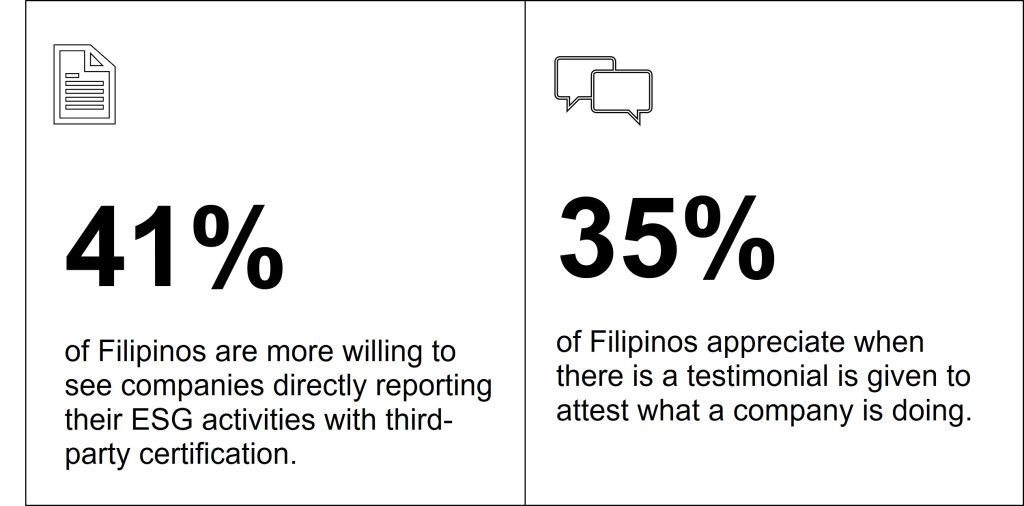
- ➣ 41% prefer third-party certified ESG reporting.
- ➣ 35% appreciate testimonials that validate a company’s claims.
Without evidence, even the strongest ESG initiatives are at risk being dismissed as performative. Proof here is literal and figurative: documented proof that policies are implemented, outcomes are tracked, and accountability is maintained.
💡 INSIGHT: ESG is both expectation and opportunity. Companies that act responsibly internally and externally curry favor with consumers.
Key Takeaways
Filipinos care deeply about corporate integrity—but understanding and trust depend on clarity and proof.
- 1. Poor and Confusing Recall: Governance is the least understood ESG pillar, with many Filipinos remain unclear on what sustainable corporate governance entails.
- 2. High Yet Undefined Concern: While Filipinos strongly oppose corruption and bribery, much of corporate governance remains abstract, leading actions to be overlooked.
- 3. Proof Builds Trust: Providing tangible resibo—evidence of ESG efforts—boosts understanding and belief in a company’s commitment.
Share


How do you feel about this article?


Survey Details
Project ESG, 2023
This survey was conducted across 17 countries, covering all major continents, with a total random sample size of N=9,627 respondents interviewed globally. In each country, a representative sample of around 400 to 1,000 men and women was randomly selected. Data was collected through a combination of face-to-face, telephone, and online interviews, using a structured questionnaire. Studies were conducted by research agency partners within AGMR.