This piece explores how awareness, class, and everyday experience shape environmental concern — and what that gap means for translating concern into action.
The Philippines: Focal Point of Climate Vulnerability
The Philippines ranks among the world’s most climate-vulnerable nations. According to the Global Climate Risk Index, it sits among the top 10 countries most affected by extreme weather events. From stronger typhoons to intensifying heat waves, environmental crises are part of the lived realities of Filipinos.
Given this, one would expect environmental awareness—particularly around frameworks like ESG (Environmental, Social, and Governance)—to be especially strong among Filipinos.
But that’s not the case. Only 1 in 3 Filipinos say they know what ESG means (without any explanation). In a country where daily survival often trumps long-term sustainability, the focus is understandably on making ends meet, not on obscure acronyms that don’t have immediate impact on their lives.
💡 INSIGHT: Filipinos don’t lack environmental concern, they lack language. They may already know — and perhaps practice — ESG, they just don’t know the term “ESG.”
The Awareness Gap
To be fair, ESG is still fairly new. Even worldwide, fewer than half of people (45%) say they’re familiar with it. The Philippines’ numbers, then, don’t reflect apathy so much as a lack of familiarity.
The concept has largely been discussed within boardrooms and financial reports—not in barangay halls or public school classrooms. ESG remains a high-level concept, causing a gap from people to understand it because of how unnecessarily complicated it can be defined as. On paper, ESG is the framework used to guide sustainability efforts. In practice for the Filipino, environmentalism has always been best rooted in the tangible: cleaner streets, safer air, clearer rivers, and the like.
What Filipinos Actually Worry About: The Personal Over the Systemic
While awareness of ESG may be limited, the concern for the environment remains high among Filipinos. Notably, a resounding 84% of Filipinos agree that environmental issues have reached crisis levels. Yet only 29% say current efforts to address these problems are sufficient—highlighting that much more still needs to be done.
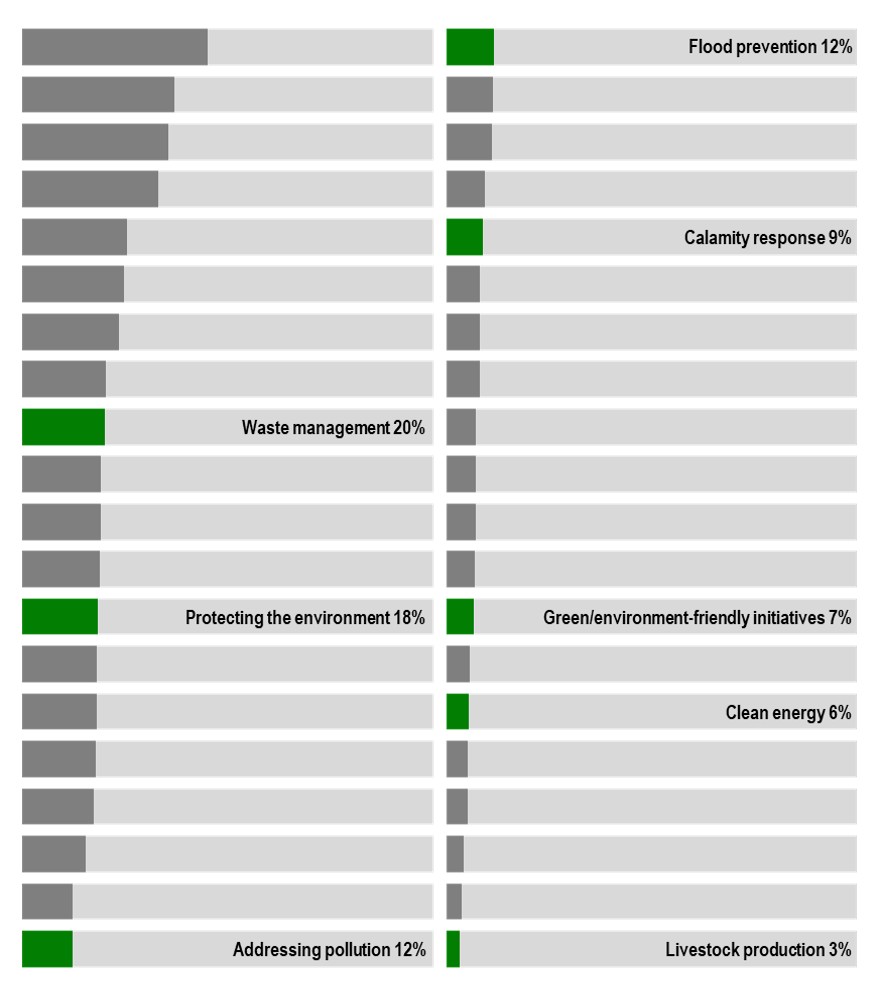
When asked what is most pressing, waste management tops the list (20%), followed by protecting the environment (18%), flood control (12%), calamity response (9%), green initiatives (7%), and clean energy (6%).
It’s telling that the issues perceived that matter the most are personally relevant. Larger, systemic issues like energy policy or climate adaptation feel remote, even if they’re deeply consequential.
💡 INSIGHT: Planting the seeds in caring for the environment begins local—because that’s where change feels possible.
The Generational Divide: The Future and the Legacy
Despite broad agreement that environmental problems are urgent, the data reveals interesting generational nuances.
Among those who named “Protecting the Environment” as a top concern, Gen Z (27%) and Boomers (20%) stand out.
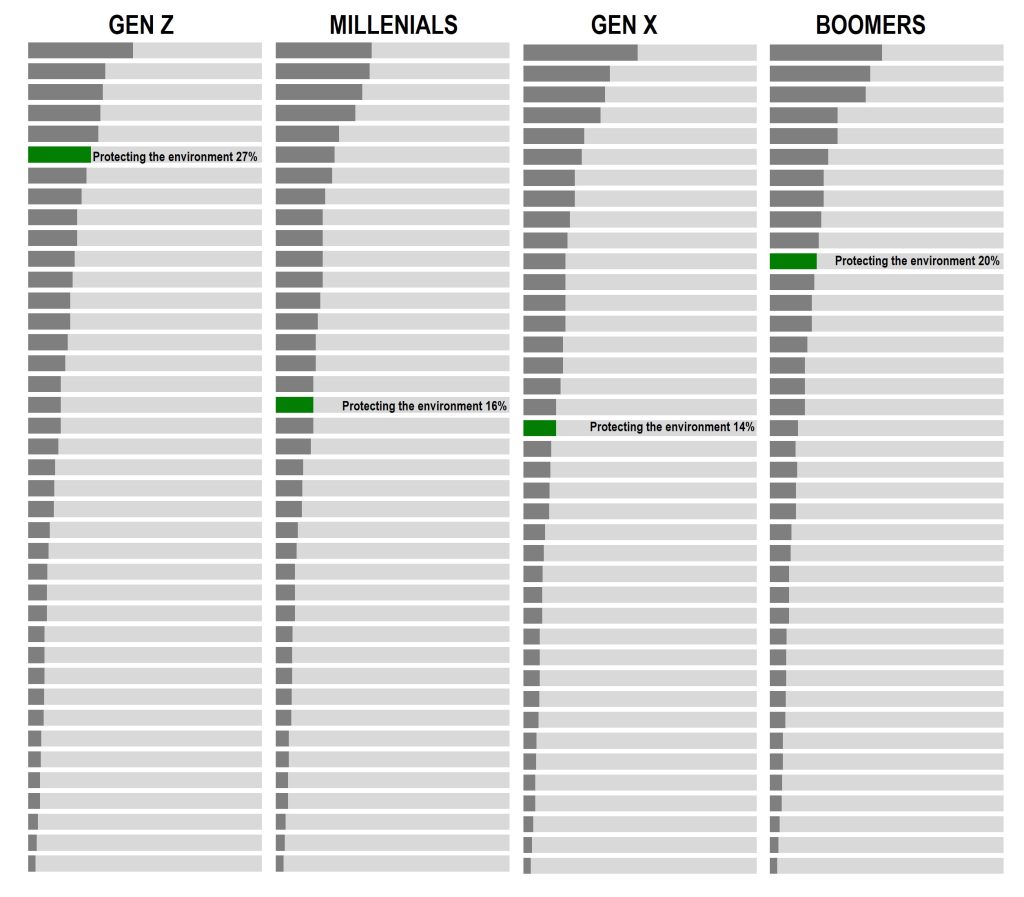 Differences in Environmental Concerns Across Generations (Project ESG 2023)
For Gen Z, the fear is existential—they’ll live through the consequences if nothing changes. For Boomers, it’s reflective—having witnessed the degradation over decades, they want to leave a better world behind.
Interestingly, environmental concern cuts across socio-economic classes and genders, suggesting that sustainability is a shared anxiety, even if motivations differ among age cohorts.
💡 INSIGHT: The environment unites generations—but for different reasons. The youngest want to improve their future, while the oldest wish to leave their legacy.
Top Causes of Environmental Degradation
When it comes to the roots of environmental problems, Filipinos point to both large-scale industrial practices and everyday human behavior.
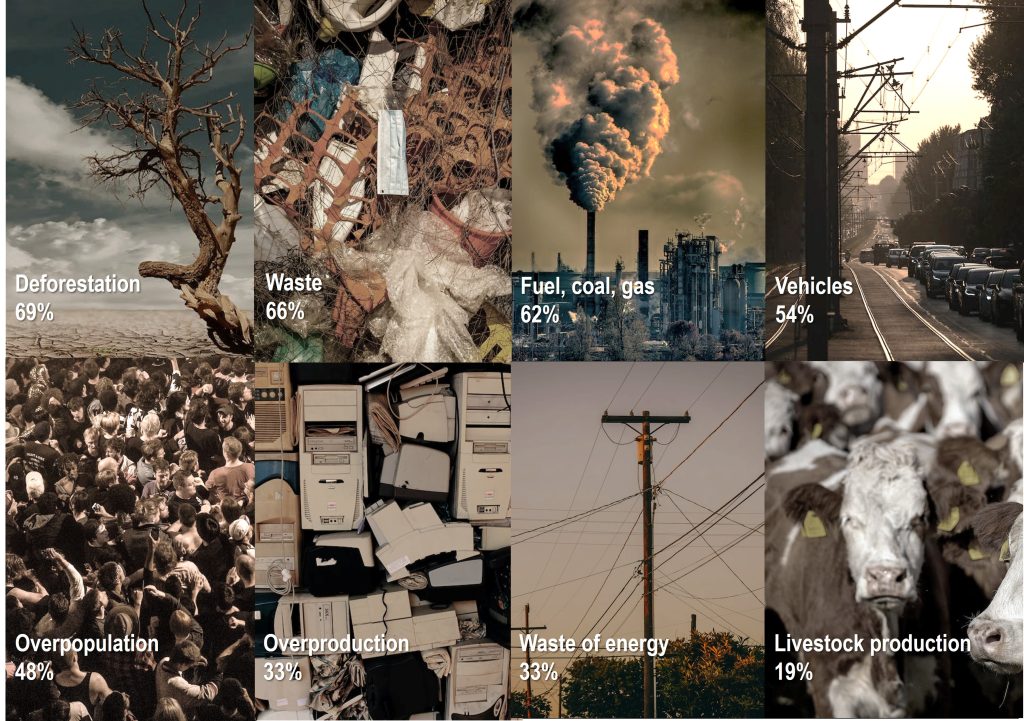
At the top of the list is deforestation (69%), followed by waste (66%) and fossil fuels (62%)—issues that are both visible and relatable. Barren forests, overflowing landfills, and fuel-dependent lifestyles are clear, tangible symbols of environmental decline.
Vehicles (54%) and overpopulation (48%) come next, reflecting urban pressures like traffic, congestion, and the strain of city living. Meanwhile, issues such as overproduction (33%), energy waste (33%), and livestock production (19%) rank lower, perhaps because they’re less visible or feel beyond individual control.
💡 INSIGHT: Visibility shapes urgency. Filipinos seem to fixate on what they can see—the visible scars of deforestation and pollution—over invisible threats like emissions or consumption chains.
Socio-Economic Lens: Who’s to Blame Depends on Where You Stand
When viewed through the lens of class, different stories emerge. Environmental concerns are universal—but how people frame the problem often reflects their lived realities.
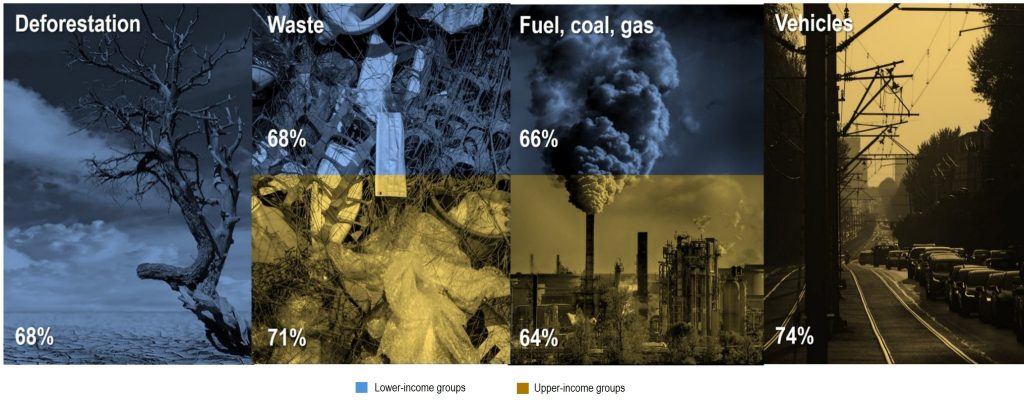
For lower-income groups, the focus falls on deforestation (68%), waste (68%), and fossil fuels (66%)—issues tied to the direct loss of resources and the absence of adequate protection. These are the communities that experience flooding, food insecurity, and displacement most acutely when the environment suffers. Their view of the crisis is shaped by survival: when forests fall, livelihoods follow.
Upper-income groups, on the other hand, see the crisis through the lens of consumption and convenience. They point to vehicles (74%), waste (71%), and fossil fuels (64%) as the main culprits—issues tied to urban lifestyles, mobility, and excess. For them, the environment is something to be preserved rather than relied upon, leading to a more consumption-centric understanding of damage.
💡 INSIGHT: Proximity influences perception. Those closest to nature see environmental loss as survival risk; those furthest see it as lifestyle consequence.
Regional View: Geography Affects Perspective
The environment means different things depending on where you live.
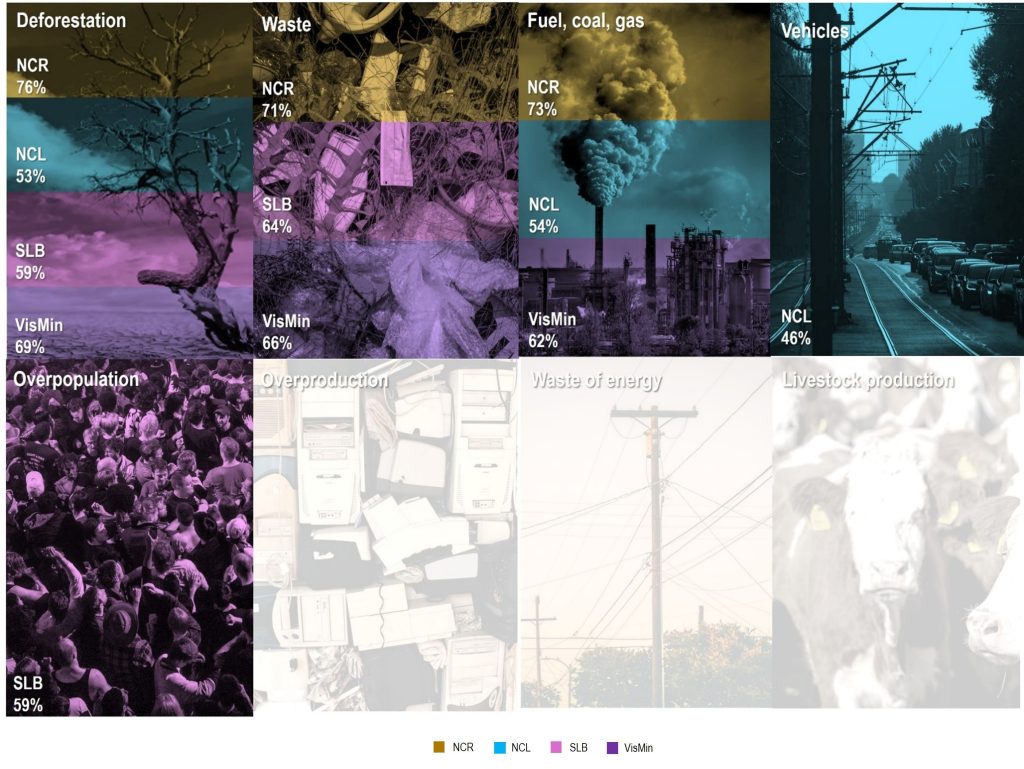
In Luzon, concerns center on balancing growth with sustainability. Urban residents worry about waste, fuel, and mobility, reflecting the pressures of density and development.
- ➣ NCR: Deforestation (76%), Fossil Fuels (73%), Waste (71%)
- ➣ North-Central Luzon: Fossil Fuels (54%), Deforestation (53%), Vehicles (46%)
- ➣ South Luzon/Bicol: Waste (64%), Deforestation (59%), Overpopulation (59%)
Meanwhile, those in Visayas and Mindanao prioritize natural resource protection—issues like deforestation (69%), waste (66%), and fossil fuels (62%) dominate, aligning with communities whose livelihoods remain tied to land and sea.
💡 INSIGHT: Filipinos’ live realities also differ depending on what’s in their proximity. The closer people live to nature, the more they feel its fragility.
Are We Doing Enough?
Despite overwhelming concern, only 29% of Filipinos believe enough is being done to protect the environment.
That said, those focused on protecting natural resources—forests, water, waste—see progress as tangible and local. Perhaps they can see clean-ups, tree-plantings, or logging bans taking effect, so the gap between concern and action feels narrower.
But for those who see the crisis in terms of consumption and urban growth, the problem feels far bigger than themselves. Their awareness is high, but their sense of agency may feel low.
💡 INSIGHT: The concern–action gap isn’t about apathy—it’s about scale. Filipinos act where they can, but environmental problems often outsize their personal efforts.
Something We Can All Agree On
While ESG may not yet be mainstream, our survey respondents agree that caring for the environment is everyone’s job.
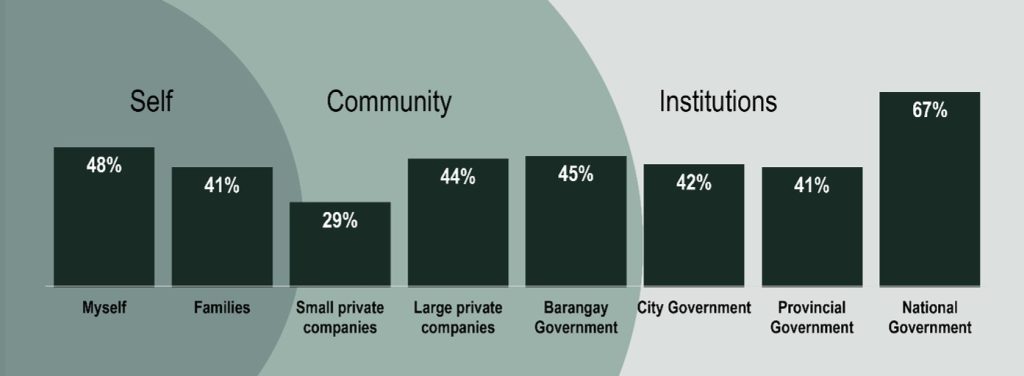
Filipinos deem themselves (47%) and their families (41%) as major players in environmental protection. That said, they expect the national government (67%), city government (42%), and small (29%) and large companies (44%) to be partners in preserving Mother Earth.
As ESG becomes better understood and adoption grows, it could provide a framework to turn shared concern into coordinated action—uniting individuals, families, and institutions in safeguarding the environment for generations to come.
Share


How do you feel about this article?


Survey Details
Project ESG, 2023
This survey was conducted across 17 countries, covering all major continents, with a total random sample size of N=9,627 respondents interviewed globally. In each country, a representative sample of around 400 to 1,000 men and women was randomly selected. Data was collected through a combination of face-to-face, telephone, and online interviews, using a structured questionnaire. Studies were conducted by research agency partners within AGMR.