From inclusivity and ethics to human rights, see how the “Social” pillar of ESG resonates with Filipinos across generations and communities.
Why Business is a Human Proposition
Companies don’t just make products or provide services — they shape livelihoods, communities, and even values.
By giving people jobs, they uplift households and enable progress. But they also leave footprints — social, environmental, and ethical.
In a country where the private sector is the largest employer, corporations wield tremendous influence over everyday lives. As such, business for profit’s sake is no longer enough. Today, doing good is good business.
And this is where the “S” in ESG — Social — takes center stage. If “E” is about the planet and “G” is about process, then “S” is about people.
Putting the ‘Social’ in Sustainability
ESG stands for Environmental, Social, and Governance — a framework that helps companies measure their impact beyond profit.
The “S” pillar focuses on people: employees, customers, communities, and society at large. It’s about how a company treats its people and the world it operates in, from fair wages and diversity to consumer protection and community development.
It’s also about trust. When companies get the “Social” aspect right, they don’t just stand to perform better — they earn brand loyalty, attract top talent, and strengthen their corporate reputation.
Social Responsibility in a Deeply Unequal Country
In a country marked by stark social divides, it’s no surprise that the “Social” pillar resonates so strongly.
Filipinos understand that prosperity isn’t shared equally, which makes fairness, opportunity, and human rights more than just ideals, they’re necessities.
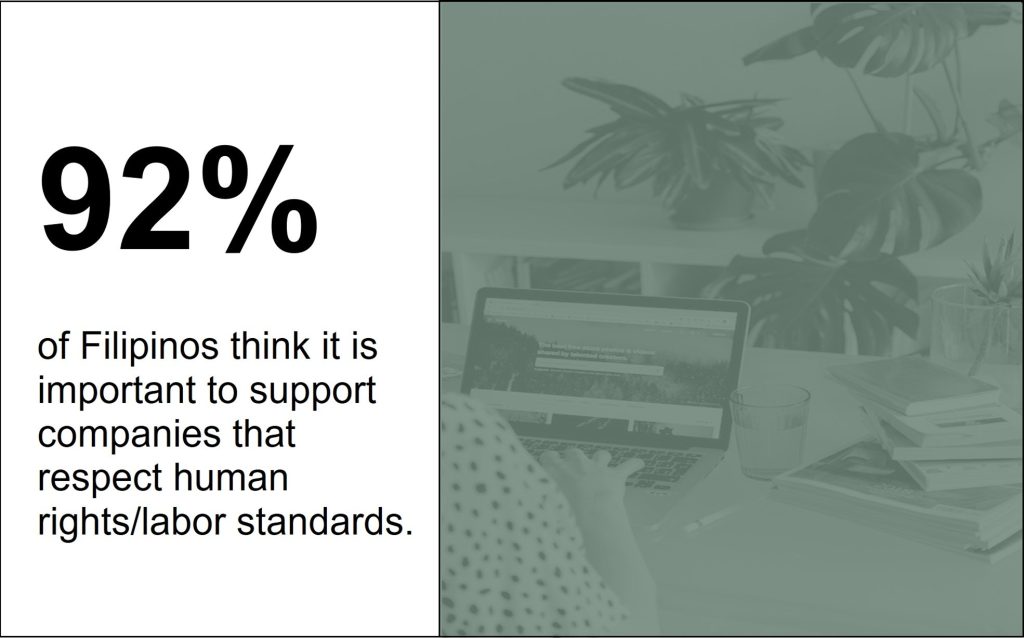
In our survey, 92% said it’s important to support companies that respect human rights and labor.
However, this understanding is still surface-level. Filipinos are only beginning to grasp the full scope of what the “Social” pillar means — beyond empathy, towards systemic fairness and accountability.
Reality Check: Social Issues Start with Survival
Dig deeper and the data reveals something telling: when people think “social,” they think survival.
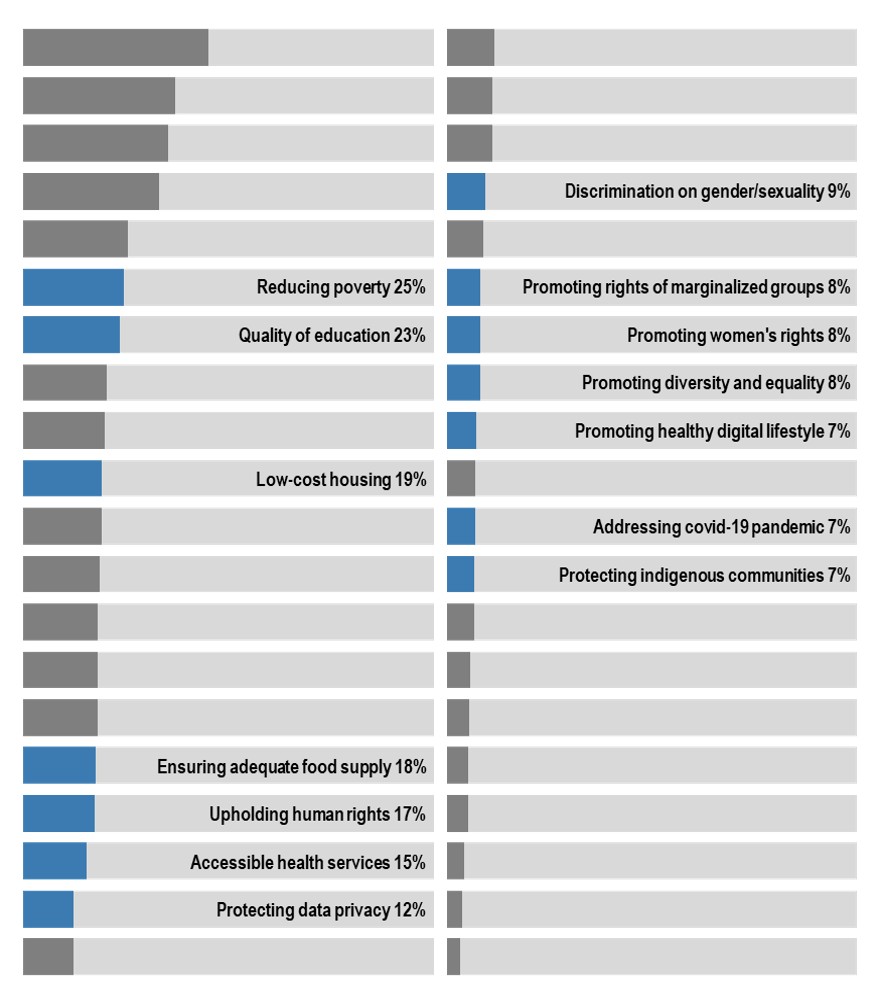
Top social concerns among Filipinos include reducing poverty (25%), quality of education (23%), low-cost housing (19%), and ensuring adequate food supply (18%).
These are not abstract policy issues — they’re daily realities. For most Filipinos, the “S” in ESG begins at the dinner table, the classroom, and the neighborhood.
Meanwhile, issues like discrimination, equality, and human rights are salient concerns that need attention.
💡 INSIGHT: Social responsibility starts where inequality is felt most: at home.
Different Generations, Different Concerns
Every generation wants a better Philippines — but their definitions of “better” differ.
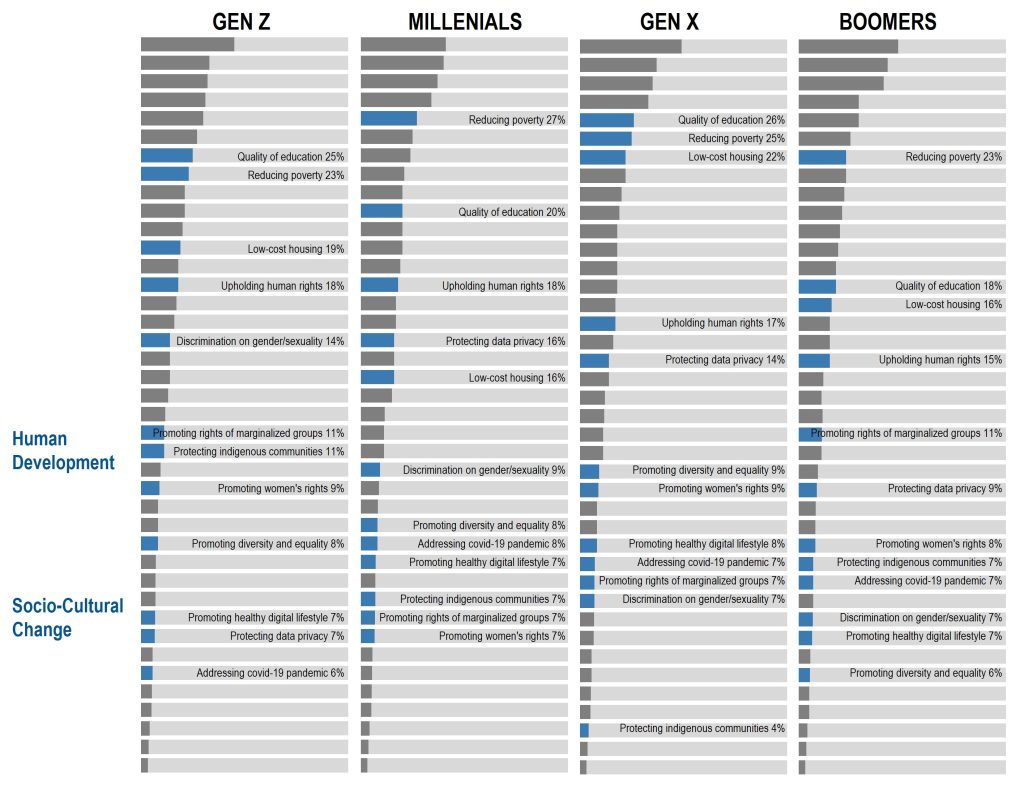
For Gen Z, education and equality take center stage: Quality of Education (25%), Reducing Poverty (23%), and Gender Discrimination (14%) rank high. This is a generation growing up hyper-aware of inclusivity and representation.
Millennials lean toward broader social justice and rights: Reducing Poverty (27%), Upholding Human Rights (18%), and Protecting Data Privacy (16%). As digital natives who came of age online, they understand both the promise and the perils of connectivity.
Gen X balances practicality with principle: Quality of Education (26%), Reducing Poverty (25%), Low-Cost Housing (22%), and Data Privacy (14%). Their priorities reflect a desire for both economic security and ethical governance.
Meanwhile, Boomers focus on stability and dignity: Reducing Poverty (23%), Quality of Education (18%), and Upholding Human Rights (15%). Perhaps as a cohort who lived through Martial Law, the defense of human rights and dignity holds a particularly strong and historical pull.
Each generation fights the same battle — just on different fronts.
💡 INSIGHT: Social issues evolve, but empathy endures. Each generation defines fairness through the lens of its own experience.
A Divide Beyond Income
Social concerns shift not just by age, but by access.
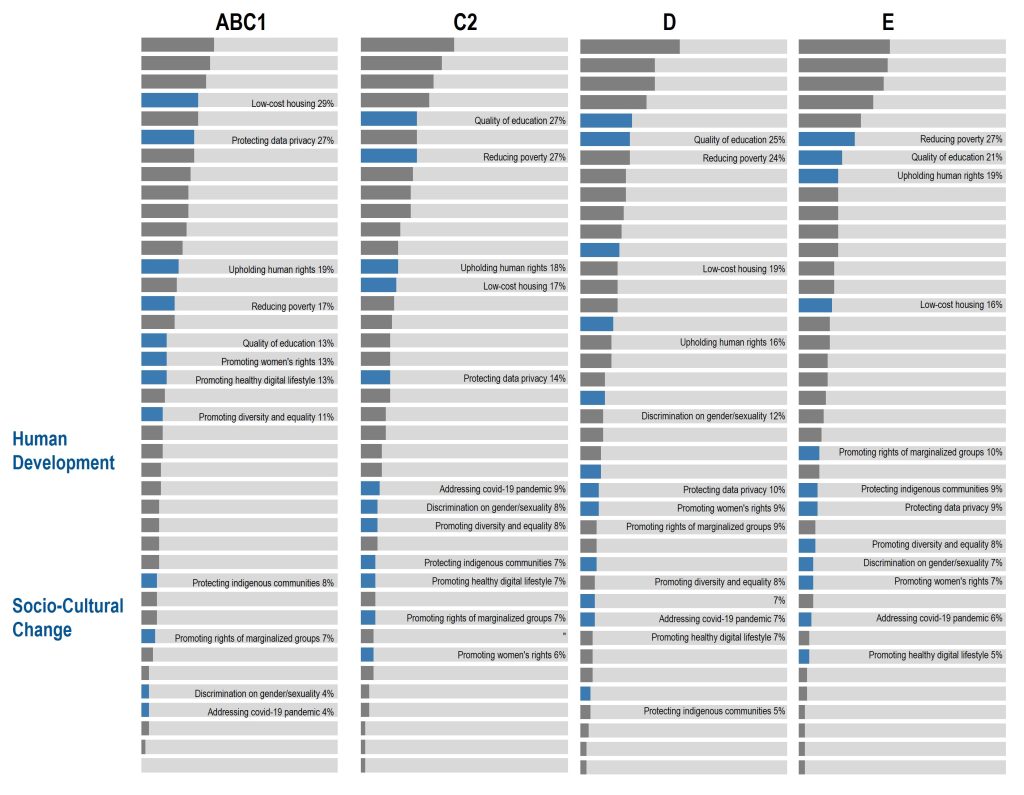
For those in upper-income (ABC1) groups, priorities lean toward protection — Data Privacy (27%), Human Rights (19%), and Women’s Rights (13%).
Meanwhile, the lower income (C2, D, E) is focused on simply getting by — Reducing Poverty (24–27%), Education (21–27%), and Low – Cost Housing (16–19%) dominate their list.
In short: privilege informs concerns. Those who have stability worry about rights; those without worry about rights and rice.
💡 INSIGHT: The “S” in ESG is lived differently across classes — for some, it’s empowerment, for others, it’s endurance.
On the Right Track
For all the challenges that persist, Filipinos still recognize and uphold the importance of human rights.
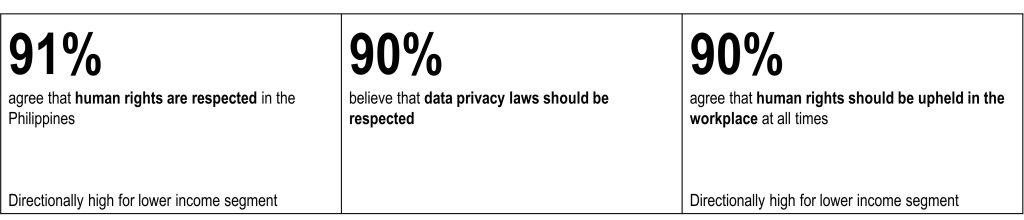
- ➣ 91% agree that human rights are respected in the Philippines — with stronger agreement among lower-income groups.
- ➣ 90% believe that data privacy laws should be respected.
- ➣ 90% agree that human rights should always be upheld in the workplace — again, directionally higher among lower-income Filipinos.
These numbers point to a nation that values dignity and fairness, not just as ideals but as expectations. Respect for rights has become a baseline for how people believe companies — and society — should operate.
💡 INSIGHT: For Filipinos, respect isn’t optional. It’s the starting point of trust.
Great Strides in Corporate Spaces
This respect extends into the workplace, where companies are making visible progress in creating fairer, more inclusive environments.
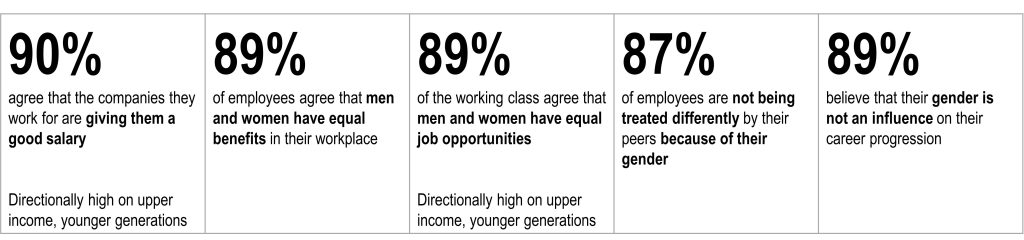
- ➣ 90% of employees say their companies pay them a good salary — a sentiment stronger among upper-income and younger workers.
- ➣ 89% agree that men and women enjoy equal benefits at work.
- ➣ 89% also say men and women have equal job opportunities — again, highest among the younger generation.
- ➣ 87% report not being treated differently by peers because of gender.
- ➣ 89% believe their gender has no bearing on career progression.
Younger Filipinos, especially Gen Zs, are benefiting most from these shifts. They report better working conditions, fair pay, and stronger gender equality — proof that company policies can translate into lived improvements.
💡 INSIGHT: Equality at work is no longer a goal — for many Filipinos, it’s becoming the norm.
Still Not Perfect
Yet, the work is far from done. Even as inclusivity grows, inequity still lingers beneath the surface.
About 9 in 10 Filipinos still believe harassment or discrimination remains a problem in the country. Survey respondents cited violence, gender discrimination, and intolerance of cultural backgrounds among examples of lingering societal issues.
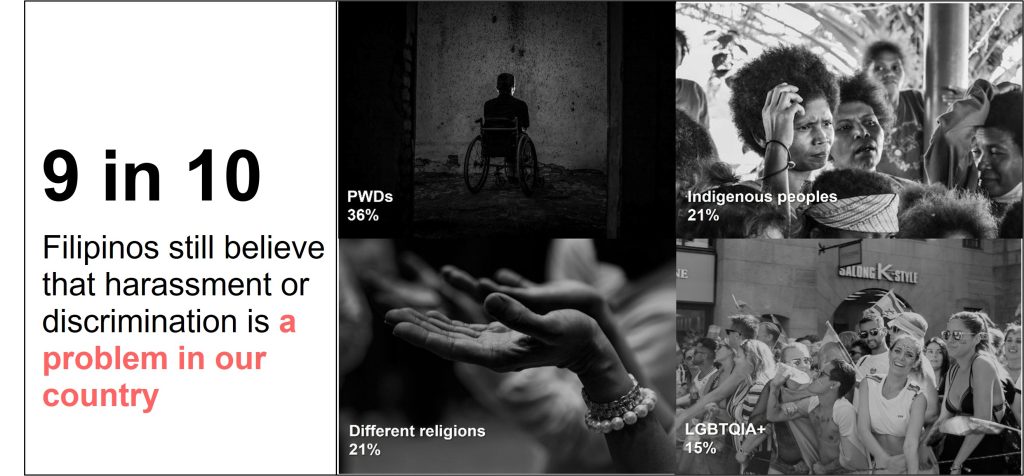
Furthermore, there is an acknowledgment that certain sectors are not treated fairly, such as: Persons with Disabilities (36%), Indigenous Peoples (21%), those with different religions (21%), and LGBTQIA+ communities (15%).
Progress has been made, but it’s uneven. While many experience fairness and respect, others remain excluded or unheard. For social responsibility to be meaningful, it must protect the margins — not just the majority.
💡 INSIGHT: Progress is measured not by how many are included, but by who still isn’t.
Key Takeaways
Filipinos clearly value the “Social” in ESG — but while the intent is strong, awareness and action still have room to grow.
- 1. Correct Association, Poor Recall: Filipinos understand what social responsibility means — inclusivity, fairness, ethics — but don’t always connect it back to ESG.
- 2. High Concern: Social issues hit close to home, especially around rights, privacy, and workplace treatment. The heart is there — it just needs clearer direction.
- 3. Insufficient Action: Progress is visible, but far from complete. As long as discrimination and harassment persist, the fight for human rights isn’t over.
Share


How do you feel about this article?


Survey Details
Project ESG, 2023
This survey was conducted across 17 countries, covering all major continents, with a total random sample size of N=9,627 respondents interviewed globally. In each country, a representative sample of around 400 to 1,000 men and women was randomly selected. Data was collected through a combination of face-to-face, telephone, and online interviews, using a structured questionnaire. Studies were conducted by research agency partners within AGMR.