54% of Filipinos currently live in urban barangays, mostly concentrated in NCR and CALABARZON. While they create centers of innovation, they also raise critical concerns, like congestion and housing.
A Majority of Filipinos Now Reside in Urban Areas
Based on the 2020 Census of Population and Housing, 58.93 million Filipinos — or 54% of the total population — now live in urban barangays[1]. This marks a 2.8% point increase from the 2015 Census of Population and Housing, where the urban population was recorded at 51.2%.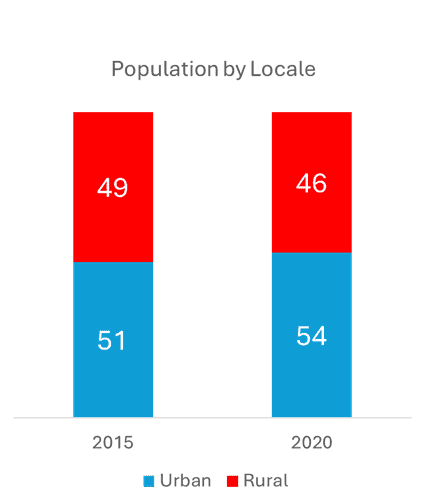
| Individual Population by Locale (based on 2015 and 2020 Census of Population and Housing) | ||
| Year | Urban | Rural |
| 2015 | 51 | 49 |
| 2020 | 54 | 46 |
Source: Highlights of the Philippine Population 2020 Census of Population and Housing (2020 CPH), Philippine Statistics Authority (PSA).
Urbanization Spikes Across Regions
Alongside the rise in urban dwellers, the number of barangays classified as urban has also increased.
From 7,437 out of 42,036 barangays (17.7% of the total in the 2015 Census of Population and Housing) this figure rose to 7,957 barangays, equivalent to 18.9% of the total in the 2020 Census of Population and Housing.
Among the administrative regions in the Philippines, the National Capital Region (NCR) and CALABARZON (Region IV-A) have earned the highest percentage of urbanization in terms of population. In NCR, every barangay is classified as urban, while 71% of CALABARZON’s population reside in urban areas.
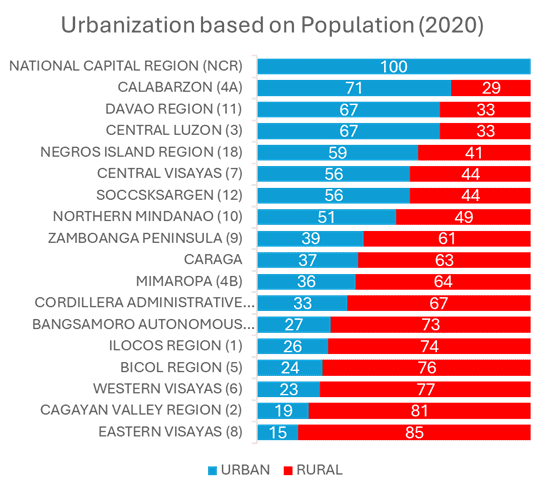
| Urbanization based on Individual Population (based on 2020 Census of Population and Housing) | ||
| Region | Urban | Rural |
| National Capital Region (NCR) | 100 | |
| CALABARZON (4A) | 71 | 29 |
| Davao Region (11) | 67 | 33 |
| Central Luzon (3) | 67 | 33 |
| Negros Island Region (18) | 59 | 41 |
| Central Visayas (7) | 56 | 44 |
| SOCCSKSARGEN (12) | 56 | 44 |
| Northern Mindanao (10) | 51 | 49 |
| Zamboanga Peninsula (9) | 39 | 61 |
| CARAGA | 37 | 63 |
| MIMAROPA (4B) | 36 | 64 |
| Cordillera Administrative Region (CAR) | 33 | 67 |
| Bangsamoro Autonomous Region of Muslim Mindanao (BARMM) | 27 | 73 |
| Ilocos Region (1) | 26 | 74 |
| Bicol Region (5) | 24 | 76 |
| Western Visayas (6) | 23 | 77 |
| Cagayan Valley Region (2) | 19 | 81 |
| Eastern Visayas (8) | 15 | 85 |
Source: Highlights of the Philippine Population 2020 Census of Population and Housing (2020 CPH), Philippine Statistics Authority (PSA).
Despite its high urban population, there are only 28 percent of barangays that are classified as urban in CALABARZON, suggesting that dense population centers coexist in largely rural administrative zones. In contrast, Eastern Visayas remains the least urbanized region in the country.
Urban Concentration and Economic Transition
Urban barangays – though still less than one-fifth of all barangays – now house more than half the population. The steady growth of urban areas reflects the Philippines’ ongoing economic transition.
This concentration presents both opportunities and challenges: while it fosters innovation, connectivity, and productivity, it also raises concerns about congestion, housing, and environmental sustainability.
Key Takeaways
- ➣ Philippines is Now Urban-Majority: Based on the 2020 Census of Population and Housing, 54.0 percent (or 58.93 million) of the total Filipino population now live in urban barangays..
- ➣ Increase in Urban Barangay Classification: The number of barangays classified as urban also rose from 7,437 (17.7%) in 2015 to 7,957 (18.9%) in 2020.
- ➣ Regional Concentration: The National Capital Region (NCR) and CALABARZON (Region IV-A) have the highest percentage of urbanization in terms of population.
- ➣ Opportunities and Challenges: This concentration of population in urban areas fosters opportunities like innovation, connectivity, and productivity, but simultaneously raises critical concerns regarding congestion, housing, and environmental sustainability.
Share


How do you feel about this article?


References:
[1] Highlights of the Philippine Population 2020 Census of Population and Housing (2020 CPH). Population and housing | Philippine Statistics Authority | Republic of the Philippines. Philippine Statistics Authority. (2021, July 13). https://psa.gov.ph/statistics/population-and-housing/node/164811