World Mental Health Day 2026 highlights how stress levels in the Philippines closely mirror the global average, while the factors behind stress differ across gender, generations, household income, and regions.
In observance of World Mental Health Day, the Worldwide Independent Network of Market Research (WIN-MR), represented locally by the Philippine Survey and Research Center, Inc. (PSRC), presents findings from the latest Worldviews Survey (WVS) on stress and mental well-being.
The study examines how frequently people experience stress, how the Philippines compares with the rest of the world, and the factors contributing to significant stress experiences among Filipinos.
Findings reveal that about 4 in 10 Filipinos frequently experience stress, nearly matching the global average. However, a closer look at the sources of stress reveals a more distinct local picture, with financial concerns and family matters outweighing several other pressures more commonly reported worldwide.
Filipinos Experience Stress at Nearly the Same Rate as the Global Average
Stress remains a common experience among people around the world, and the Philippines is no exception.
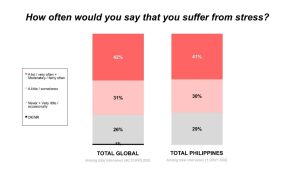
The latest WVS findings show that 41% of Filipinos report experiencing stress often, nearly identical to the global average of 42%. Another 30% of Filipinos experience stress sometimes, while 29% report experiencing it very little, occasionally, or never.
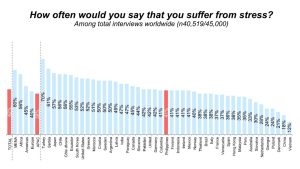
While the Philippines closely mirrors the global picture, its reported level of frequent stress is slightly higher than the Asia-Pacific (APAC) regional average of 38%. However, stress levels vary considerably among countries within the region—Turkey records the highest at 70%, Vietnam reports the lowest at 12%, and the Philippines sits somewhere in the middle at 41%.
These findings suggest that while stress is widely experienced across different parts of the world, its frequency is not uniform, even among countries within the same region.
Women and Those in Luzon Report More Frequent Stress
Within the Philippines, the experience of stress also differs across demographic groups.
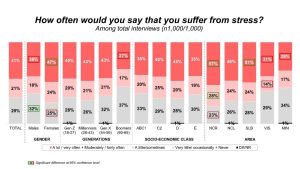
Women are more likely than men to report frequent stress, with 47% experiencing it often compared with 36% of men. Conversely, men are more likely to report experiencing little to no stress.
Geographical differences are similarly pronounced. Frequent stress is highest in the National Capital Region (NCR), where 57% of respondents report experiencing it often, followed by South Luzon and Bicol (SLB) at 51%.
Generational differences are also evident as more frequent stress is relatively consistent among younger and middle-aged groups. About 40% of Gen Z, 43% of Millennials, and 43% of Gen X report experiencing stress often, then the figure falls to 27% among Boomers.
Taken together, these findings show that while stress cuts across different segments of Filipino society, women and those living in Luzon, particularly NCR, report experiencing it more frequently.
Financial Concerns Are the Leading Source of Stress Among Filipinos
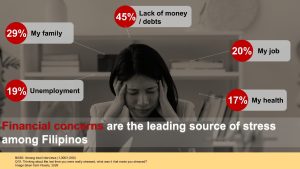
Beyond how often stress is experienced, the survey also examines the circumstances behind respondents’ most recent significant stress experience.
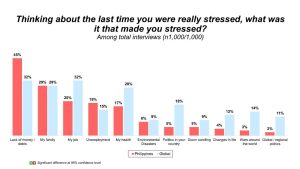
Lack of money or debt emerges as the leading source of stress among Filipinos, cited by 45% of respondents, substantially higher than the global average of 32%.
Family-related concerns follow at 29% equal to the global average. Job-related stress ranks third at 20%, followed by unemployment at 19% and health concerns at 17%.
The results reveal a notable difference between the Philippines and the wider global picture. While financial concerns and family matters are the most reported sources of stress locally, job-related pressures and health concerns carry greater weight globally.
Other concerns, including political developments, changes in life, and wars around the world, are also reported less frequently by Filipinos than by respondents globally.
These differences suggest that stress among Filipinos is more strongly associated with immediate financial and household concerns, while the global picture reflects a broader range of work-related, health, and external pressures.
Different Sources of Stress Affect Filipinos in Different Ways
While financial concerns are the leading source of stress among Filipinos, the survey reveals that the factors behind stress differ across gender, generations, household income, and regions.
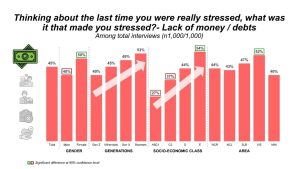
Financial concerns become more prominent among women, older generations, and lower income households. Half of Filipino women (50%) cite lack of money or debt as a source of stress. Financial stress also increases across generations, from 40% among Gen Z to 53% among Boomers. A similar pattern emerges across household income, with financial concerns reported by 54% of those in Class E, compared with 27% among ABC1.
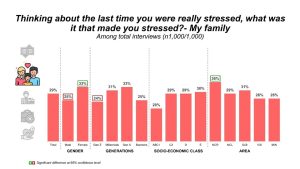
Family-related concerns are more commonly reported among women and residents of NCR. About a third of women (33%) identify family as a source of stress. Family-related stress is also particularly prominent in NCR, where 36% cite it as a contributing factor, higher than the national average of 29%.
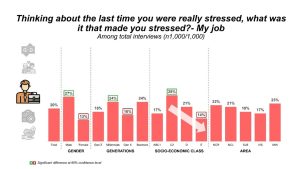
Meanwhile, job-related stress is more prevalent among men, Millennials, and the C2 households. Men are more than twice as likely as women to cite their job as a source of stress, at 27% versus 13%. Job-related concerns are also more frequently reported among Millennials (24%) and those in the C2 households (28%).
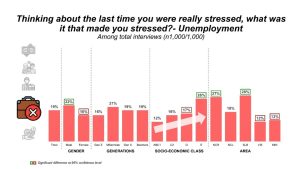
Unemployment-related stress is more pronounced among lower income households and those living in Luzon. The proportion citing unemployment rises from 12% among ABC1 to 26% among class E. Geographically, unemployment is more commonly identified as a source of stress in NCR (27%) and South Luzon and Bicol (28%), compared with 19% nationally.
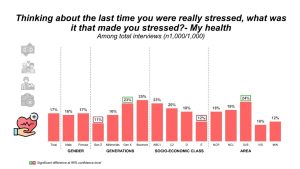
Health-related concerns become more prominent among older generations and in South Luzon and Bicol. While only 11% of Gen Z identify health as a source of stress, this increases to 23% among Gen X and 25% among Boomers. Health concerns are also more frequently cited in South Luzon and Bicol (24%), compared with the national average of 17%.
Taken together, these findings highlight how the sources of stress vary across different segments of the Filipino population. It illustrates that although stress is a shared experience, the pressures behind it are closely associated with people’s circumstances, life stage, economic situation, and location. Financial pressures remain the most widespread concern, but family responsibilities, work, unemployment, and health contribute differently depending on people’s life stage, socio-economic circumstances, and location.
Understanding Stress Means Looking Beyond How Often It Happens
The latest Worldviews Survey highlights how closely the Philippines mirrors the rest of the world in terms of the frequency of stress, while revealing distinct differences in what contributes to it.
About 4 in 10 Filipinos experience stress often, with women and residents of Luzon reporting higher levels. Financial concerns remain the most prominent source of stress, particularly among women and lower socio-economic groups, while job-related, family, unemployment, and health concerns affect different segments of the population in varying ways.
These findings underscore that understanding stress requires looking beyond its overall prevalence. The experiences and circumstances of different groups provide important context for identifying where pressures are most strongly felt.
This World Mental Health Day, the results offer a broader perspective on mental well-being in the Philippines and highlight the importance of recognizing the different financial, family, work-related, and health concerns that shape Filipinos’ experiences of stress.
Download the 2026 World Mental Health Day Report here
Share


How do you feel about this article?


Survey Details
This Worldviews Survey 2026 is an initiative of the Worldwide Independent Network of Market Research and Opinion Poll (WIN-MR), represented by the Philippine Survey and Research Center locally. The worldwide study covers a total of 45,000 persons across 45 countries. In the Philippines, face-to-face interviews were conducted among 1,000 randomly sampled respondents that is nationally representative. Philippines’ survey covers males and females, 18 years old and above, covering nationwide urban and rural areas, and across all socio-economic classes, with margin of error of +/- 3% at 95% confidence level.
Have any questions? Send us an email at research@psrc.com.ph