World Animal Day 2026 highlights the place pets hold in Filipino households, with more than half reporting pet ownership and many seeing their pets as protectors, children, or valued members of the family.
In commemoration of World Animal Day, the Worldwide Independent Network (WIN), represented locally by the Philippine Survey and Research Center, Inc. (PSRC), presents findings from the latest Worldviews Survey (WVS) on pet ownership and attitudes toward pet care.
The study offers a closer look at how common pet ownership is around the world and in the Philippines, which animals are most likely to be found in Filipino homes, and how Pinoy fur parents view the role of their pets within the household.
Pet Ownership Is Common Both Worldwide and in the Philippines
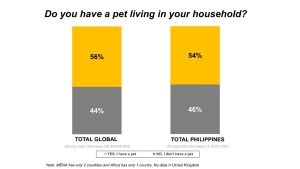
More than half of households surveyed worldwide have at least one pet. Globally, 56% report having a pet at home, compared with 44% who do not. The picture is similar in the Philippines, where 54% of households report owning a pet, while 46% do not.
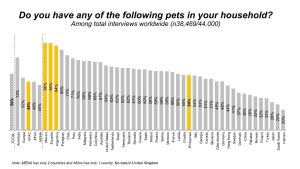
Pet ownership, however, varies considerably across markets and regions. The Americas record the highest regional incidence of pet ownership at 72%. Several Latin American markets are among those with the highest levels of pet ownership—led by Mexico and Ecuador 86% each, Argentina at 84%, and Paraguay at 80%.
At 54% in the Philippines sits slightly below the global average of 56% but above the Asia-Pacific average of 48%. Pet ownership in the Philippines is also higher than in several Asian markets, including Hong Kong at 44%, China at 36%, Japan at 28%, South Korea at 25%, and Vietnam at 20%.
The results illustrate how the role of pets differs from one market to another, while showing that pet ownership remains a familiar part of everyday household life for many people around the world.
The More Affluent Report Higher Ownership
Within the Philippines, pet ownership also differs across demographic groups.
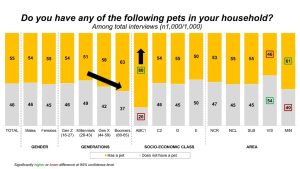
The most pronounced difference is seen by socio-economic class. Among ABC1 households, pet ownership rises to 80%, substantially higher than the national incidence of 54%.
Age also shows an upward pattern. About 54% of Gen Z report having a pet, compared to 51% of Millennials. This increases to 58% among Gen X and 63% among Boomers.
Location also plays a role. Mindanao records the highest pet ownership incidence at 61%, while Visayas registers the lowest at 46%.
Overall, the findings suggest that while pet ownership cuts across different segments of Filipino society, it is especially common among more affluent households and tends to increase among older age groups.
Dogs Remain Man’s Best Friend, Both Among Global and Filipino Citizens
Dogs and cats continue to dominate pet ownership worldwide.
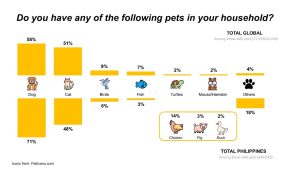
Among pet-owning households globally, 58% have a dog and 51% have a cat. Dogs are even more prominent among Filipino owners. Seven in ten, or 71%, report having a dog in their household, while 48% own a cat.
The Philippines also shows a wider variety of animals kept at home. Eighteen percent of Filipino pet owners report having pets outside the main categories covered in the global comparison. Chickens are the most common among these at 14%.
For many Pinoy fur parents, dogs remain the clear favorite. At the same time, the presence of cats, chickens, and other animals highlight the variety of ways pets and domestic animals from part of Filipino household life.
Filipinos See Their Pets as Protectors and Treat Them with the Same Care
|
For Filipino pet owners, the relationship with an animal often extends beyond simple ownership. |
|
|
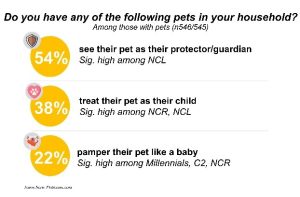
More than half, or 54%, say they see their pet as their protector, a view that is significantly more common among respondents in North/Central Luzon. Another 38% say they treat their pet as their child and 22% say they pamper their pet like a baby. Together, these findings point to the different roles that pets can assume inside Filipino homes. They may serve as guardians, companions, or even be treated much like children—reflecting the close attachment some fur parents develop with the animals under their care. |
 |
|
|
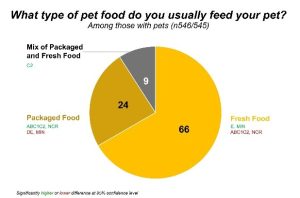
How pets are cared for also reflects differences between households. Among Filipino pet owners, 66% usually feed their pets fresh food, while 24% use packaged food and 9% provide a mix of packaged and fresh food.
The differences in pet-care practices may be influenced by a combination of household resources, location, and what is readily available at home. |
Majority of Households Own at Least One Pet and See Them as Guardians or Valued Members of the Family
Taken together, the findings reinforce how common pet ownership has become in Filipino households.
More than half of Filipinos surveyed have a pet at home, while ownership becomes considerably more widespread among more affluent households. Dogs remain the most common pet among Filipino owners, followed by cats, while chickens also account for a notable share of animals kept in households.
More importantly, the results suggest that the relationship between Filipinos and their pets goes beyond ownership alone. Pets can be protectors, companions, or family members, with some Pinoys treating and pampering them in much the same way they would a child.
As WIN Association President Richard Colwell puts it:
“Pets are increasingly part of how families define themselves, not a luxury reserved for specific groups of people. As pet ownership keeps growing worldwide, these regional and demographic differences will matter well beyond market research, from consumer goods to urban planning and public health.”
The findings provide a snapshot of the evolving place animals occupy in households, both locally and globally. This World Animal Day, they also offer a reminder that understanding pet ownership is not only about how many households have animals, but also about the different roles those animals play in people’s everyday lives.
Share


How do you feel about this article?


Survey Details
This Worldviews Survey 2026 is an initiative of the Worldwide Independent Network of Market Research and Opinion Poll (WIN-MR), represented by the Philippine Survey and Research Center locally. The worldwide study covers a total of 45,000 persons across 45 countries. In the Philippines, face-to-face interviews were conducted among 1,000 randomly sampled respondents that is nationally representative. Philippines’ survey covers males and females, 18 years old and above, covering nationwide urban and rural areas, and across all socio-economic classes, with margin of error of +/- 3% at 95% confidence level.
Have any questions? Send us an email at research@psrc.com.ph