From misconceptions to lived experiences, members of the queer community set the record straight.
The Power of Speaking Your Truth
As a group that is subjected to misrepresentation, LGBTQIA+ Filipinos have long had their stories filtered through the lenses of mainstream media, religious institutions, and prevailing social norms.
But who can and is more suitable to define what it means to be queer than those who live that truth? Through focus group discussions with members across the LGBTQIA+, we explored the most common misconceptions about the community—and what its members have to say about them.
While these insights are drawn from a study conducted in 2012, their relevance remains today. We discovered five powerful contrasts between the different societal views towards the community and the members themselves at that time. Contextualized in the present day, these contrasts benchmark the progress made since then, and how our friends and family in the LGBTQIA+ community see themselves—not as stereotypes, but as full, complex human beings with dreams, values, and depth.
UNPRODUCTIVE vs. PRODUCTIVE
In 2012, the LGBTQIA+ community was often viewed as unproductive. Commonly associated with the term “salot,” they faced criticisms that limited their movements—from possible opportunities to their freedom to express themselves. Despite this, they continued to persevere and challenge the labels placed on them in society.
The Misconception:
LGBTQIA individuals—referred to as bakla or tomboy—are often dismissed as idle, loud, or lacking ambition. Influenced by how media had portrayed them throughout the years as “tambay” and “parloristas,” it became a common stereotype in society.
“Kapag sinabing tomboy ka, tingin sa’yo ng mga tao, wala kang kwenta…Para kang pakalat-kalat sa daan.”
— Lesbian
The Reality:
Many take pride in providing for their families, pursuing excellence not to prove others wrong, but to prove themselves right—through different aspects such as performing well at work, inspiring others, and earning respect through their determination and efforts. For most in the community, work is more than a means to earn rather, it’s a statement of dignity, gratitude, and love.
“Kalahati ng sweldo ko napupunta sa mga magulang ko. Hindi nila ako ino-obliga pero gusto kong tumulong sa
kanila.”
— Gay
💡 INSIGHT: For queer Filipinos, productivity is an act of care. Work is one of the means to express care for their loved ones—through resilience and the respect they receive in return.
IMMORAL vs. SPIRITUAL
In dominant religions in the Philippines, homosexuality is often viewed negatively. Most condemn same-sex relationships, seeing them as immoral and believing they should not be encouraged in society.
The Misconception:
Members of the LGBTQIA+ community are immoral, their members continuing to struggle emotionally and reflect on themselves and their identity— often seeking forgiveness. As a result, LGBTQIA+ relationships are equated with sin or moral failure, leading them to feel guilty for who they are.
“God created Adam and Eve Wala kami dun.”
— Trans-woman
“I feel sorry everyday. I pray na patawarin ako kasi lesbian ako, pero dito kasi ako masaya.”
— Lesbian
The Reality:
Faith continues to play a vital role in the lives of many queer Filipinos. Spirituality becomes a source of comfort, strength, and meaning—not in spite oftheir identity, but because of it.
“I always pray at night. My partner and I had our Holy Union already. Kami-kami lang, exchange of vows lang
talaga.”
— Lesbian
“Lagi kong ipinagdadasal ang mga mahal ko sa buhay… Alam ko naman ang Diyos na meron ako ay mabait.”
— Gay
💡 INSIGHT: Being queer and being spiritual are not contradictions. For many, faith is both refuge and rebellion—a way to stay connected to love in all its forms.
PROMISCUOUS vs. FAITHFUL
The Misconception:
Gay and queer individuals are often labeled as promiscuous or incapable of commitment—viewed as people who engage with strangers in unconventional places. This leads heterosexuals, particularly males, to feel uncomfortable with them due to stereotypes rooted in assumptions about casual sex and infidelity.
“Kapag papasok ka ng public CR at nakita nilang long hair ka, tatakpan na nila! Akala mo porke’t bakla ka
kukunin mo yung kanila.”
— Gay
“Kapag bakla ka, iniisip ng mga tao puro lalaki lang ang nasa isip mo!”
—Gay
The Reality:
Contrary to these assumptions, many queer Filipinos are in long-term, committed partnerships. Some have even held private union ceremonies or introduced their partners to their families, affirming both loyalty and love.
“Magkasama kami ng partner ko sa house ng parents ko. 3 years na kami together… Lagi kaming magkasama sa
lahat ng bagay.”
— LGBTQIA+ individual
“12 years na kami ng partner ko. Since high school pa, kaya asawa na rin ang tingin ko sa kanya.”
— LGBTQIA+ individual
💡 INSIGHT: Love in the queer community is not fleeting—it is faithful, patient, and often hard-won. Their relationships are anchored in choice, not chance.
DESPERATE vs. HOPEFUL
The Misconception:
Queer individuals are often perceived as desperate in love—willing to go to extreme lengths just to find or maintain a romantic relationship. This stereotype is fueled by the assumptions that LGBTQIA+ relationships are short-lived, criticized, or not accepted by society or even their own families.
“Sabi nila ang mga tomboy, yan ang papatay o kaya magpapakamatay dahil lang sa pag-ibig! Pwede ba?! Kung
ayaw mo sa akin e di wag!”
— Gay
The Reality:
Despite these misconceptions, most queer Filipinos maintain a positive outlook on love and relationships. Many plan for their futures, dream of shared homes, and even aspire to have children—whether through adoption, donors, or chosen family structures.
“Kahit iba yung relasyon na meron ako, nangangarap pa rin ako na makabili kami ng sarili naming bahay ng
partner ko, magkaroon kami ng anak…Sana magkasama na kami sa sarili naming lugar at eventually
makasal.”
— LGBTQIA+ individual
💡 INSIGHT: Hope is the driver of queer love. Their relationships are guided by intention, planning, and optimism—even when the world tells them otherwise.
UNCERTAIN vs. GOAL-ORIENTED
The Misconception:
Queer individuals are often perceived as having no direction in life, their existence seen as chaotic or aimless—a perception shaped by stereotypes of unproductivity, immorality, promiscuity, and desperation.
“[Ang mga lesbian raw] ang mga walang direksyon sa buhay. Tambay lang. Puro barkada!”
— Lesbian
“Walang kapupuntahan [ang buhay nila]. Mga walang direksyon ang buhay!”
— Gay
The Reality:
In truth, many queer Filipinos are highly motivated in their personal and professional lives. Their drive is often fueled by love for their families, the desire for stability, and the pursuit of meaningful goals.
“Hinuhusayan ko ang trabaho ko kasi gusto ko maging regular. Yun ang gusto ko mangyari sa buhay ko sa
ngayon.”
— LGBTQIA+ individual
“Kailangan kayod ka kahit irate ang mga kliyente mo… Kailangan mo ng pera.”
— LGBTQIA+ individual
💡 INSIGHT: Direction is defined not by where you start, but by what keeps you moving—and for queer Filipinos, that’s love, family, and pride.
Shifting Perspectives: From Constrained to Openness
While misconceptions persist, many LGBTQIA+ Filipinos feel that societal attitudes are gradually shifting. Visibility, representation, and acceptance have grown in ways that were unimaginable a generation ago.
Icons of queer culture had growing visibility, serving as symbols of possibility and pride. Back then, individuals like Aiza, now Ice Seguerra, or beloved personalities such as Boy Abunda, Vice Ganda, and Anton Diva represented the community.
Today, several new icons have emerged in the community, including Marina Summers, Gian Bernardino, Michelle Dee, and Maxie Anderson—people who continuously inspire those who identify with the LGBTQIA+ community and society at large. Their presence signals that being openly queer in the community is not only possible but also respected and celebrated by others.
“Dati bawal maging bakla! Closeta ka na lang habang buhay!”
— LGBTQIA+ individual
“Mas madali na matanggap ang mga lesbyana ngayon kesa dati, dahil andyan na ang pambansang tomboy na si
Aiza.”
— LGBTQIA+ individual
“Hinahangaan na nila ngayon ang mga bakla. Andyan si Boy Abunda, si Vice Ganda, si Anton Diva!”
— LGBTQIA+ individual
These examples demonstrate that what was once hidden, stigmatized, or silenced is now being accepted and embraced by the community. Shifting from traditional perspectives, members of the queer community continue to take space in presenting themselves with their authenticity, expression, and recognition—leaning toward inclusion and societal acceptance.
Universal Needs: What Queer Filipinos Seek
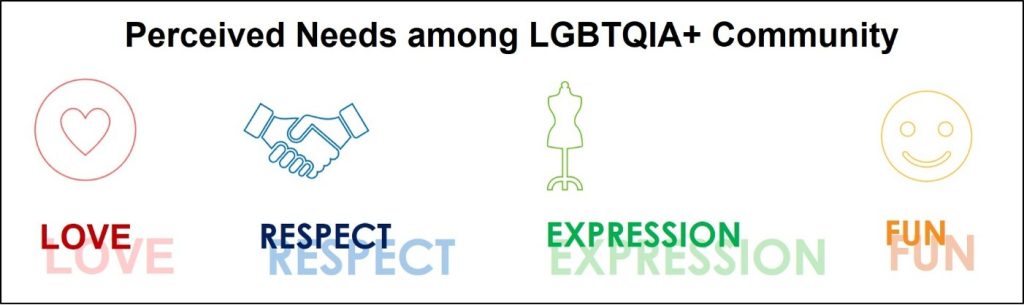
This study revealed that, at their core, queer Filipinos yearn for the same fundamental things as everyone else.
- ➣ The Need for Love: Queer Filipinos, like everyone else, long for love that is unconditional, affirming, and accepted by both family and society.
- ➣ The Need for Respect: They seek recognition for who they are—valued not only for their talents, contributions, and decisions, but also for their identity.
- ➣ The Need for Expression: The community yearns for the freedom to express themselves fully, through fashion, speech, creativity, or relationships, without fear of judgment or restriction.
- ➣ The Need for Fun: Joy, laughter, and playfulness are essential—especially for queer individuals navigating a world that can sometimes be hostile, as humor and positivity become tools for resilience and self-affirmation.
LGBTQIA+ Filipinos have often been defined by stereotypes and misconceptions rather than their own voices. These experiences show they are productive, faithful, expressive, and full of joy—clearing the misconceptions made by the society about them. An act of empowerment by reclaiming the narrative and crafting a new perspective by themselves that represents who they really are.
Share


How do you feel about this article?


Survey Details
Project Pink, 2012
This research employed Focus Groups Discussions (FGDs) as the primary methodology. The groups were characterized by a free-wheeling discussion format where freedom of expression was encouraged. The discussions were moderated by a trained facilitator and guided by a discussion guide to ensure all pertinent topics were covered. The discussions predominantly utilized open-ended questions to facilitate in-depth probing on the topics.
The focus group participants were drawn from individuals across nine distinct LGBTQIA+ segments, all residing in C1C2 homes. The sample included Lesbians (Females, 20-40 years old) separated into “Male looking” and “Straight female looking” groups; Gays (Males, 20-40 years old) segmented into “Female looking” and “Straight male looking” groups; and a separate group for Transsexuals (25 to 35 years old). For both the Female and Male segments, the groups were further broken down by age, spanning from 20 to 40 years old (specifically 20-30 and 31-40 age brackets).